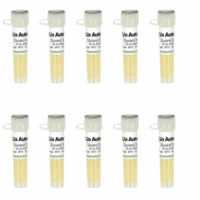
T3021- Mix & Go! XJa Autolysis Competent Cells, 1 ml 500x L-Arabinose – 10 x 100 µl- Zymo Research

$241.00
While there are many cell lysis methods available to scientists, unfortunately none of these methods combine all the ideal features for simple, efficient, economical, and gentle lysis of E. coli cells. The E. coli XJ autolysing strains from Zymo Research were engineered to address this problem. Mild expression of a chromosomally encoded bacteriophage λ R gene, encoding the λ lysozyme, also known as λ endolysin, is induced during growth. Cells are harvested intact while the peptidoglycan layer of the cell walls has been protected from digestion by the cytoplasmic membrane. The membrane is, however, amenable to disruption by a brief physico-chemical stress such as a freeze-thaw cycle after harvesting the cells. The XJ Autolysis™ method is highly efficient and takes only minutes (unlike traditional multiple freeze-thaw cycles). It can be applied to any number of samples without increasing processing time and labor (unlike sonication or French-press), is reliable and repeatable (unlike lysozyme treatment), and finally, is fully compatible with a wide range of buffers. Additionally, it does not require use of any potentially interfering components such as detergents, commonly found in various lytic buffers. They are also applicable for nucleic acid purification, and available with a DE3 lysogen encoding the T7 polymerase for expressing recombinant proteins driven by the T7 promoter.
| Technical specifications | |||||||
| Autolysis | Lyses easily. The parent strain JM109 itself will release about 20% of cellular protein after one freeze-thaw cycle. This strain will lyse in a wide range of buffer conditions. 80-90% of E. coli are lysed after a single freeze-thaw treatment. | ||||||
| Cell Growth | Grows well, especially when medium is supplemented with 1 mM Mg2+ | ||||||
| DNA Extraction | This strain is EndA- and yields high quality DNA preparations. | ||||||
| DNA Stability | The RecA- mutation in XJa stabilizes repetitive DNA sequences | ||||||
| Genotype | F`[traD36 proA+B+ laclq ∆(lacZ)M15] ∆(lac-proAB) glnV44 (supE44) e14- (McrA-) thi gyrA96 (NalR) endA1 hsdR17(rK- mK+) relA1 recA1 ΔaraB::λR, cat (CmR) | ||||||
| Processing Time | 10 minutes | ||||||
| Product Storage | -70°C to -80°C | ||||||
| Protein Expression | Suitable for general screening, but proteases may degrade small or otherwise unstable recombinant proteins. | ||||||
| Transformation Efficiency | 108– 109transformants per µg of plasmid DNA | ||||||